Sunday, September 23, 2012

SUP mold

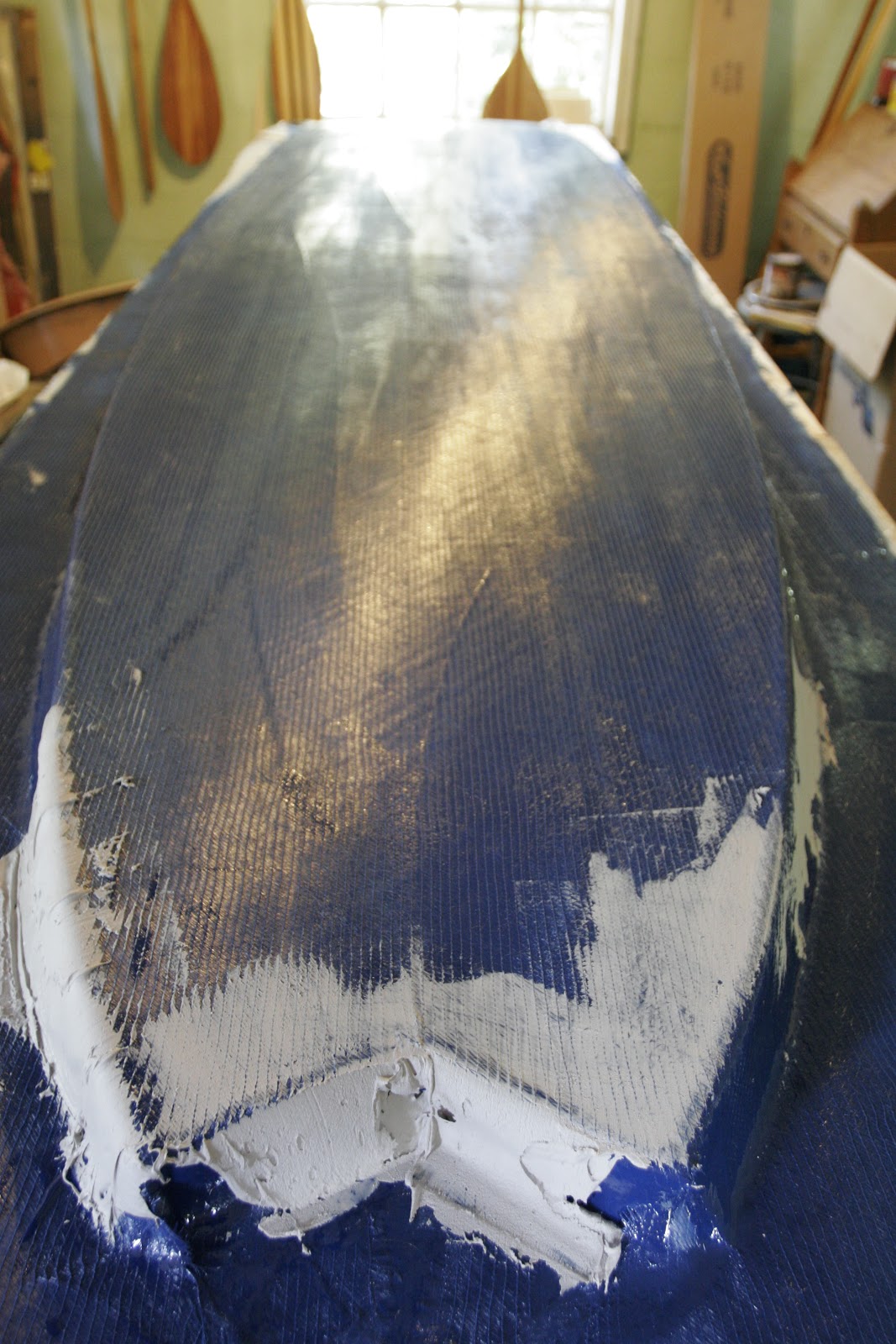
On Friday we had the plug polished and ready, so we sprayed on PVA and prepared to make the mold.  To have everything organized is essential with such a big part.  We precut the variety of cloths used for the mold.  We made sure all the supplies were at hand including a fresh bucket of Vinyl Ester, latex gloves, several respirators etc.
We sprayed on a tooling gel coat Friday night and on Saturday morning we started a wet layup of the mold.  We ended using about 3 gallons of resin.
On Sunday after lunch we were able to easily free the mold and quickly declared victory.  The mold is nice and clean.  There are a couple of voids we will fill and polish in the morning.
On Tuesday we plan on forming our first part from this mold.

This photo (added Oct 7th) is of the first part pulled from the mold:


The mold just after it was popped off the plug.  Wooden shims and plastic wedges are used to prevent scratches.
The mold has some stringers embedded to add strength.  This mold should be able to produce  many parts.

The mold before washing off the pva skin.


Monday, September 17, 2012

Skiff at Polestar Marina show

We had the skiff out this past weekend at  Polestar Marina.  There was a car and boat show.
Here is  a photo of it with it's new gunnel.
We sold the Johnson 25 because it was just too large an engine for this hull.  The power was no problem but the weight made the stern sit too low in the water.
The ideal size would be a 5 to 15 horse power.
We are looking for an older Evinrude of Johnson.  The older styles look better on this boat than a newer motor.  Of course a brand new Mercury would look pretty good too.


Friday, September 14, 2012

Paddle Board the next step

Yesterday evening we sprayed on a second layer of gelcoat.  The fairing process is getting very close.  With this last coat we changed colors.  When sanding it allows you to see when you are through the top coat.  We have a couple of spots we are going to fair out then she will be ready to polish.


Tuesday, September 11, 2012

Paddle Board plug fairing

Today we spent some time fairing the plug for the paddle board.  It was first formed with 1/8 inch ply. bi-axiel glass cloth and resin.  We then formed the rails with fairing compound and lots of it.
Once it got close, we gel-coated it.  Getting the plug back to a uniform color with gelcoat helps in the fairing department.  It is easier to see problems.  So today we re-faired and tomorrow it will get another gelcoat layer.  At that point we should be getting real close to polishing time.


Monday, September 10, 2012

Carbon Fiber molding

We have worked out all the kinks in the carbon fiber molding of our Cahokia blades.
The blades are made with a 6.2 oz large checkerboard weave carbon cloth.
Initially we where having bubbles in the finished surface that required either rejecting the part or costly finish re-work time.  Our improvement came when we modified our vacuum form to pull the bagging film from above the part with no breather material.
It progressively clings to the part and does not trap air.

The parts spend little time in the vac because we still have Missouri summer weather.  We pop them free and set them in the sun to finish curing.  We will shortly get on the shaft mandril form.  That will be fun to figure out.

Stay tuned...


Sunday, August 26, 2012

SUP paddle blades shipped to Hemel

Last week we shipped out the first set of sup paddle blades to Hemel Board Company in Seattle.
Steve DeKoch's company is busy building a delivering their line of SUPs and we are able to supply a co-designed blade to their shop.
The first shipment included 4 glass cahokia blades in blue and 1 in carbon fiber.  These blades fit on a 1 &1/8 inch (id) shaft.  We bought shafts from Nimbus paddles for our camp order and Hemel will most likely use these as well.
We are currently building a mandril to spin cast our own shafts, but this will take awhile to perfect.
We will post some photos of it as it gets closer to completion.

The blades have Hemel branding.
Also included was a set of handles and a handle display.


Monday, August 20, 2012

Summer boating: Dauphin Island

We headed down to the Gulf Coast for a family getaway.  Once again the skiff sat on the sidelines.  We rented a van and couldn't tow it.  But we had some great times with our two kayaks.  Dauphin Island, Alabama was our destination.  It is a great place.  Lot's of rental houses as well as year round residence.  No big commercial condo buildings and lots of great fishing.
We rented a house on the bay side of the island and it had water access.
Here are some photos:

Indian shell mound park
This hill is made of oyster shells, hundreds of thousands of oyster shells.


Spanish moss on a live oak (also known as goat trees)


Paddling out to the sea marker.

Wednesday, August 15, 2012

Mississippi River Skiff: Outer Gunwale

The Mississippi River Skiff is getting a few finishing touches.  Yesterday we installed the outer gunwale.  It is composed of two trim profiles cut out of Poplar.  The first piece covers the glass skin of the hull and wraps around to the inner gunwale.  On top of that is set a half round of Poplar.
These were epoxied to the hull.


Friday, July 27, 2012

Sea State SUP

We are building a flat water SUP.   We have had fun using some Hemel's and a few lesser brands.   But, it turns out it is less expensive to build the plug, mold and board than buying a decent SUP, so we are going into production.
Since this board will be built and sold in the midwest, we designed a board for flat-water use.  It has a longer flat mid-section, no overall rocker and just a bit of nose and tail lift.  The dimensions will be 10'10"  with a beam of 31".

St. Louis Sail and Paddle has asked me to teach a couple of boat building classes this winter.
This SUP will be built as a hull with the option of a strip built wood deck.  It can be purchased as a kit (Hull plus wood and glass for the deck) and it will be one of the choices for the boat building class.

There will be a size limit to the class of about 10 projects.  We are also looking at a small sailing dingy (the British Moth).  This boat will be offered as a kit for the St. Louis Sail and Paddle class.
If you are interested in these classes.  Please inquire about them.

(To see our current SUPs, click on the SUP's link in the menu bar.)

Thanks,
David Kreutz
314 308-3753


Swallow tail SUP

Plug molding: SUP's nose

Wednesday, July 18, 2012

Carbon fiber molding

We bought a few yards of plane weave carbon fiber cloth to see what all the fuss is about.
We have used carbon fiber tape in all the ferrules and throats of our blades.  It seemed to raise the breaking strength of the ferrule but we haven't gotten scientific about destructive testing yet.
But low and behold, blades made exclusively with CF are noticeably stiffer and over 2 oz lighter.
Here is the cloth we are using:


Tuesday, July 10, 2012

Sailing the canoe

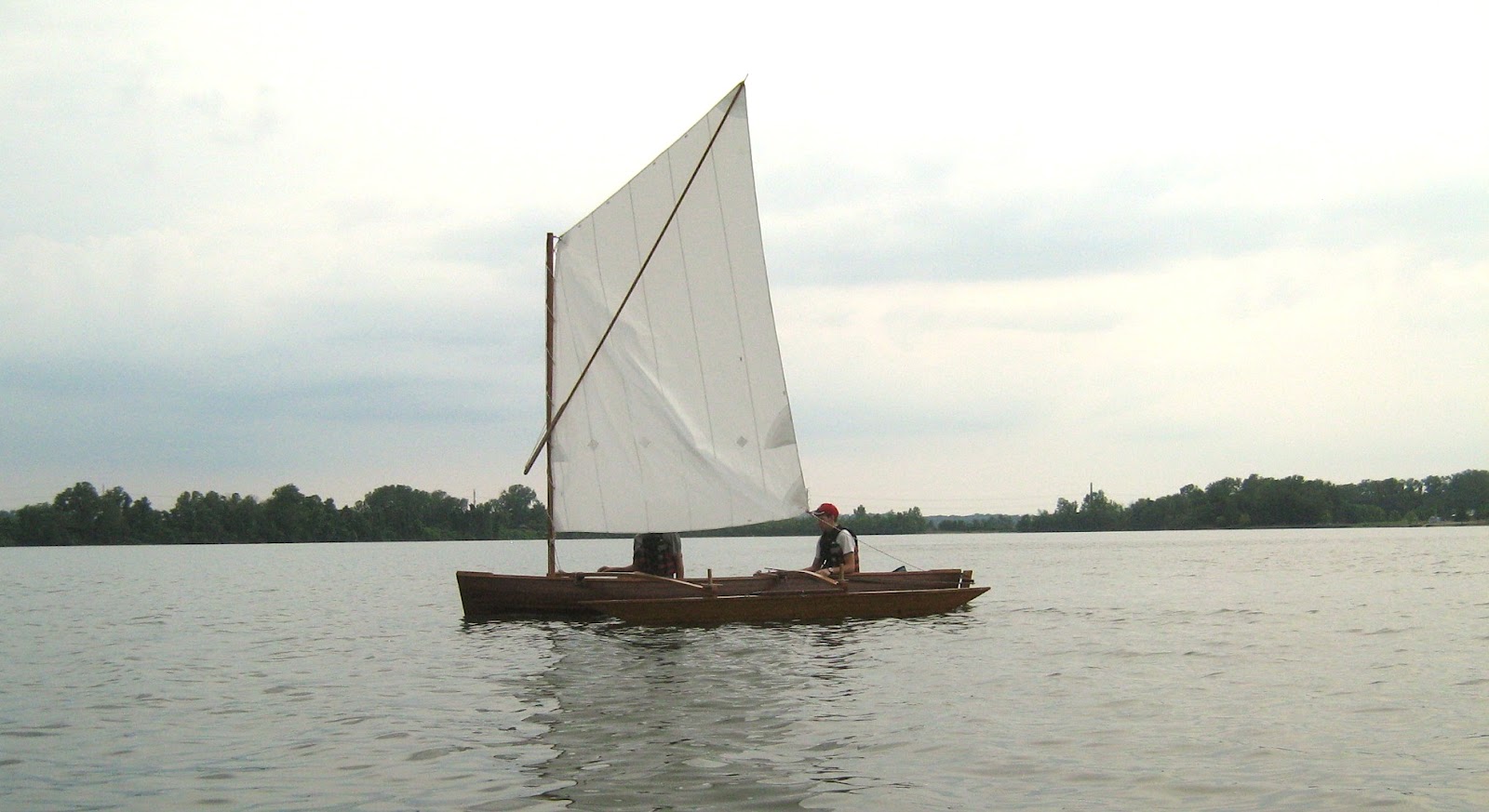
We took the canoe out on a brief test sail with it's new sail.  The wind started out fluky then a stiff breeze kicked in before a thunderstorm arrived.  The sail performed well and the canoe scoots.
Here are some photos:


Friday, July 6, 2012

Fitting the sail

We set up the sailing canoe in the yard today to fit the sail.
The mast was built to fit the luff of this particular sail (Sailrite's Footloose kit).  The tack of the sail sits at a good height so the forward seating position is usable and comfortable without having to dive under the sail when coming about.
We new that we were going to have to get creative with the rigging for the main sheet.  Since there is no boom on this sail, there is no mid-boom sheeting which would work well.   It looks like we will place a sheave on a swivel on the stern deck and lead the sheet forward.
We will try this arrangement and see how we like it.

To finish the sail we placed #4 grommets in the corners of the sail and #1 grommets up the luff.